
Filmmaking Compromise
Considering the Cost of a 3-Minute Video in 2026
by Jerome Dulin
It is 3:00 A.M. in Tuguegarao City. The tricycles outside have long gone quiet, and the oppressive daytime heat has finally dropped. But inside one bedroom, the lights are wide open.
A filmmaker is staring at a laptop, scrolling through Shot Deck for hours to find the perfect visual pegs for a client proposal. In the next room, his family is fast asleep. To them, this pagpupuyat looks like aimless sleeplessness. To him, it is the invisible, unpaid hustle required to build a creative career.
He hops on a video call with his cinematographer friends to pitch the project. There are no corporate retainers here. The deal is sealed with a familiar phrase: “Ikaw na bahala sa akin.” They agree, connect through the visuals, and hope for the best.
But the real battlefield of independent filmmaking doesn’t happen on set. It happens across a café table.
The Anatomy of the Café Pitch
On the day of the presentation, the team arrives depleted. Only two or three members can make it—the rest are stuck at their day jobs or trying to finish their college degrees.
The client squints at the mood boards. They don’t quite get the cinematic vision, so the filmmakers quickly pivot, pulling up existing YouTube videos and online campaigns just to make them say yes. The storyline is compromised on the fly, watered down for commercial safety.
Then, over a table of food and drinks ordered just to build rapport, comes the ultimate question:
“Magkano ba?”
For a serious corporate video—a three-minute campaign complete with free photoshoots and branding thrown in—the project leader pitches a modest ₱50,000.
The client pauses, smiles, and drops a tactical bomb:
“May iba nga, twenty thousand lang.”
A silent, panicked look passes between the crew members. The client pays for the food, but the budget is dead. To save the deal, the team negotiates down to ₱35,000, promising even more free revisions. As they leave, the editor is already doing the grim math of dividing a shrunken pie, staying positive, and hoping this client will at least refer them to someone else.
The Hidden Squeeze: Why Creative Gear is Skyrocketing
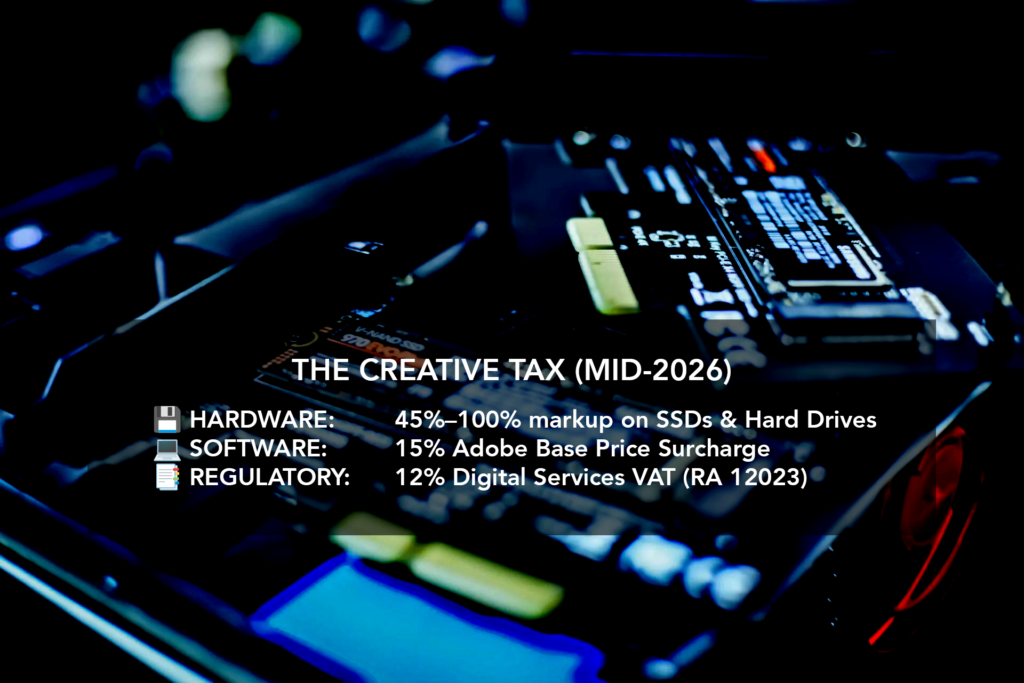
What clients don’t see is that in July 2026, the cost of being a creator has drastically shifted. We are facing a headline inflation rate of 6.4% (up from 5.4% in 2023). But for filmmakers, the real killer isn’t the price of groceries—it’s a global hardware crisis known as the “RAMpocalypse.”
Thanks to the global Artificial Intelligence (AI) boom, chip manufacturers have stopped making cheap consumer parts to focus on high-margin AI data centers. The result? A brutal tech crunch on local retailers like IT World, DynaQuest, and Bermor Techzone:
- The SSD Spike: A standard 1TB NVMe SSD that cost ₱2,700 in 2024 now clears ₱4,700 to ₱5,000+.
- The Storage Trap: Old-school hard drives used for archiving old footage have surged by 60% to 100%. A baseline 1TB drive is now ₱3,200+, forcing local filmmakers to buy risky, second-hand drives just to keep their computers from crashing.
On top of that, the virtual world has gotten more expensive. Adobe passed on its AI research costs to consumers with a 15% price hike, and the Philippines’ new Republic Act No. 12023 slapped a mandatory 12% Digital Services VAT on platforms like Google Drive, Canva, and Adobe.
When a filmmaker has to pay 12% more for cloud storage, 15% more for editing software, and 100% more for physical hard drives, a ₱20,000 client budget is no longer just a low offer—it’s financial suicide.
The "2K Compromise"
Because filmmakers cannot afford to constantly upgrade their laptops in this economy, they are being forced to process tomorrow’s data demands on yesterday’s machinery.
A 4K video timeline will instantly freeze an older computer, causing catastrophic software crashes mid-deadline. To survive, regional video teams have quietly adopted a tactical regression: The 2K Compromise.
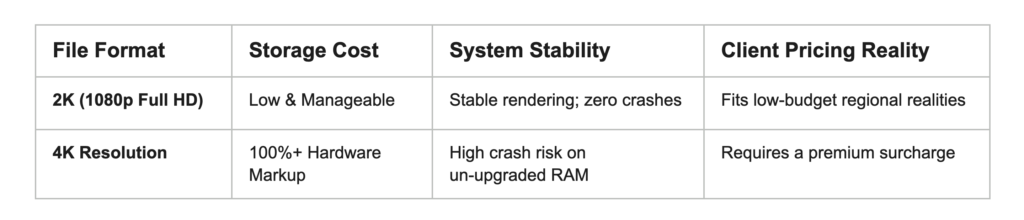
By intentionally capping shooting formats at 2K, filmmakers save their equipment and protect their timelines. It’s an act of economic survival.
The Invisible Labor of the Pitch
The biggest problem in the local creative economy is that the pitch is treated as a free audition, rather than the deployment of hard-won expertise.
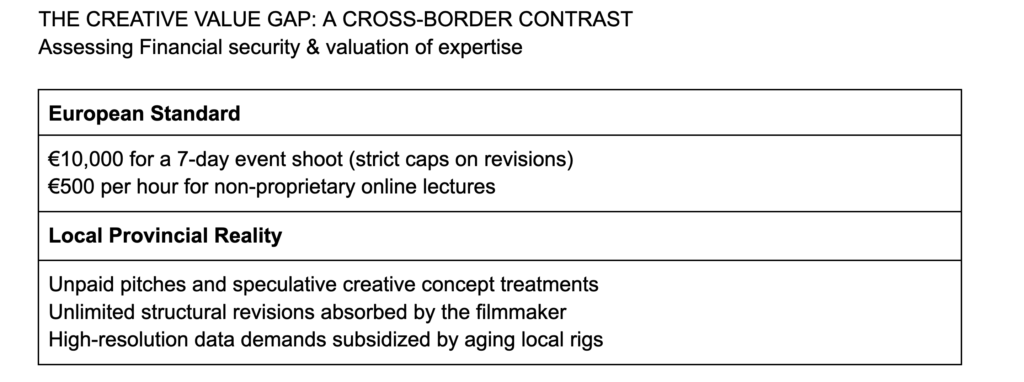
Look at the global gap: A solo videographer covering an event in Spain for seven days can easily command €10,000 (around ₱630,000) with a strict cap on revisions. An international creator giving a one-hour online lecture can easily bill Sub-clients €500.
In the Philippines, a freelance creative is expected to spend days structuring narrative arcs, scouting locations, and building treatments completely for free, only for those hours to be dismissed by clients as “standard overhead.”
Yes, we have new laws. Republic Act No. 11996 (The Eddie Garcia Law) mandates 14-hour workday limits and set safety, enforced by a legal unit inside the Film Academy of the Philippines (FAP). We also have Republic Act No. 11904 (The Creative Industries Law) to support freelancers.
Yet there is a bittersweet truth to these safeguards: they tend to cradle only those woven into official guilds or business registries. For the independent voice crafting art on its own terms, the path is still largely walked unaccompanied.
Saving Grace: The Local Thrive
How do filmmakers in Tuguegarao survive a hostile global tech market and low local rates? They turn inward.
Where macroeconomics fail, the Tuguegarao creative community steps in to keep artists grounded:
- Art Markets & Spaces: Organized by the Yavu Collective to buy and sell art directly.
- Film Festivals & Education: Driven by the North Luzon Cinema Guild, Inc., alongside the TugueGiraw Film Festival and Kultura Film Festival.
- Music & Visual Arts: Kept alive by collectives like Northern Roots and the Cagayan Artists Group Inc., alongside independent graphic artists like Hench Dulin, vloggers, and upcyclers.
Even local infrastructure has adjusted. The Cagayan Museum and Historical Research Center curates and markets regional art online. Local business patrons have turned their establishments into alternative screening rooms and galleries—places like Patio Enrico, Balai Carmella, and Uma give filmmakers a sanctuary when mainstream venues are too expensive.
The Takeaway
In the film world, we are trained to believe that more pixels equal better art. But the global tech crunch has proven otherwise.
Choosing 2K over 4K isn’t a lack of ambition—it’s a brilliant economic defense. A story’s worth isn’t measured by the gigabytes it occupies on an expensive SSD, but by how it moves an audience once the render is finally complete.
Until the market corrects itself, local creators will keep pushing boundaries with the tools they have, proving that resourcefulness, not resolution, is the ultimate creative weapon.
Hopefully, the next time a filmmaker sits down at a café table, the client across from them will finally understand the true value of the image.
What’s your experience dealing with client negotiations or gear prices this year? Let’s talk about the creative hustle in the comments below!